
You feel it when you stand up, when you warm up, when you try to train like you used to. That nagging joint or tendon problem is not just annoying – it changes how you move, how you sleep, and how confident you feel pushing your body.
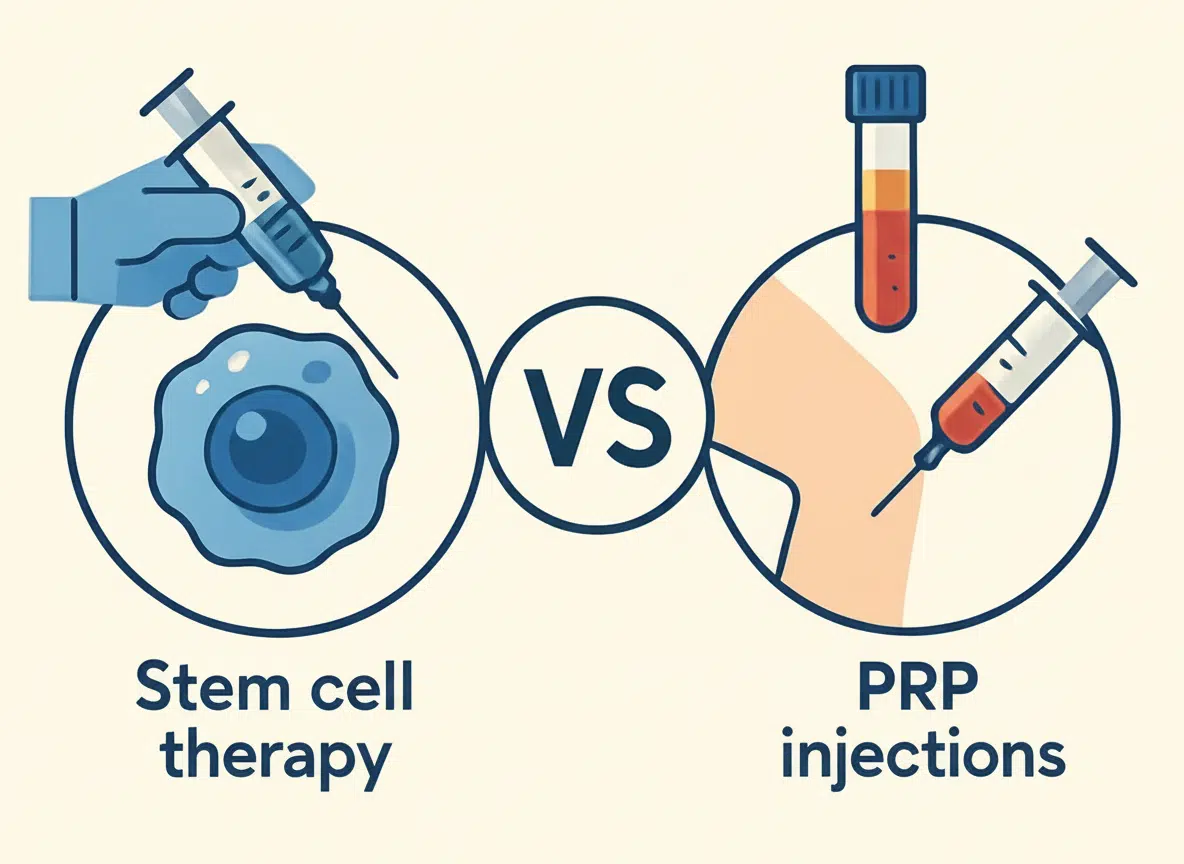
If you are weighing stem cell therapy vs prp injections, you are already past the basic stuff. You are looking at regenerative options that aim to support tissue repair and recovery instead of just masking symptoms. The smartest move is not picking the “stronger” buzzword. It is matching the right tool to your tissue, your timeline, and your tolerance for cost, downtime, and uncertainty.
The real difference is what you are asking your body to do
PRP is fundamentally a “signal booster.” It uses your own blood to concentrate platelets and growth factors, then delivers that concentrate back into a target area. The goal is to amplify the body’s existing repair signaling and kickstart a healing response.
Stem cell therapy, most often discussed as mesenchymal stem cells (MSCs) in the wellness and regenerative space, aims to do more than signal. MSCs are studied for how they communicate with tissue through cytokines, growth factors, and immunomodulatory effects, potentially influencing the local healing environment. People pursue it when they want a more comprehensive “cellular” approach, especially when the issue feels chronic, degenerative, or stuck.
Both are typically used in orthopedics and sports-performance circles for joints, tendons, and soft tissue injuries. Both can be paired with smart rehab. Neither is a magic wand.
PRP injections: what they are best at
PRP tends to shine when the problem is more “repairable” than “worn out.” Think irritated tendons, mild-to-moderate soft tissue problems, or situations where the tissue has blood supply and can respond to a focused inflammatory and growth-factor signal.
A practical way to think about PRP is that it leans into the body’s normal healing cascade. You are concentrating the ingredients your body already uses to orchestrate repair. That is why PRP is often discussed for tendinopathies and certain ligament or muscle issues, and sometimes for mild joint changes.
The experience is usually straightforward. Blood draw, processing, then injection. The real variable is the protocol: platelet concentration, whether leukocytes are included, the injection technique, and the clinician’s targeting. Outcomes can vary because PRP is not one standardized product.
In the days after PRP, many people feel a flare – soreness, heat, stiffness. That is often part of the intended response, but it is still a trade-off if you need to be functional immediately.
Stem cell therapy: what people are aiming for
Stem cell therapy is chosen when someone wants a bigger lever, especially for long-running joint pain, recurring injuries, or recovery that has plateaued. MSCs are researched for their ability to influence inflammation and tissue remodeling through paracrine signaling – meaning the “messages” they send may matter as much as their ability to differentiate.
In performance and longevity-minded circles, the appeal is simple: if the local tissue environment is the bottleneck, a cellular therapy may be a more powerful nudge than growth factors alone.
That said, stem cell therapy is also the option where quality, sourcing, handling, and clinical process matter even more. Not all “stem cell” offerings are equivalent, and consumers need to ask better questions than “How many cells?” The right questions are about what type of cells, how they are prepared, and what the clinical plan looks like before and after.
Stem cell therapy vs prp injections for common use cases
The cleanest way to compare them is by tissue type and the story your injury tells.
For tendon issues, PRP is often a first regenerative step because tendons respond to growth-factor signaling and structured loading programs. If the tendon problem is chronic, repeatedly flares, or is paired with broader joint degeneration, some people consider moving beyond PRP.
For osteoarthritis or degenerative joint pain, PRP can help some people, especially earlier in the process. Stem cell therapy is typically the “bigger swing” option that people explore when the joint feels like it is trending the wrong direction and they want a more intensive regenerative strategy.
For acute strains or partial tears, PRP is sometimes used with the goal of improving healing quality and time to return. Stem cells are more commonly discussed when an injury is not healing normally or when there is a complex history.
The point is not that one is always superior. It is that PRP is often used when the body still has a clear path to heal, and stem cell therapy is often pursued when that path looks blocked or the tissue environment needs deeper support.
Timeline: what “working” actually looks like
PRP is rarely instant relief. Many people feel worse before they feel better. It can take weeks to notice meaningful change, with continued improvement over a couple months depending on the tissue.
Stem cell therapy is also not instant, but the timeline can feel different. Some people report early improvements in pain and function, while deeper changes – if they happen – tend to show up over months. If you are trying to decide based on how fast you can get back to training, do not assume the more advanced option is the faster option. Rehab and load management are still the long pole.
A useful mindset is to treat both as an investment in tissue quality. If you only measure success by what you feel next week, you can make the wrong call.
Cost and value: where people get tripped up
PRP is generally less expensive and more accessible. That makes it attractive as a first-line regenerative option, especially for people who want to “test” how responsive their body is to this category of therapy.
Stem cell therapy is typically a bigger financial commitment. The value proposition is not “it costs more so it works better.” The value proposition is that you are choosing a different biological approach that may be better suited to certain chronic or degenerative patterns.
If you are price-sensitive, the best question is not “Which is cheaper?” It is “Which has the highest chance of moving my specific issue forward?” Paying less for the wrong option can be the most expensive route if it delays real progress.
Safety and the kind of soreness you should expect
Both PRP and stem cell therapies are commonly positioned as using biologics rather than drugs, but that does not mean they are risk-free. Any injection-based procedure has considerations like pain flare, infection risk, bleeding, and post-procedure limitations.
PRP is autologous, meaning it comes from your own blood. That is a selling point for many people. The trade-off is that the “product” depends on your physiology. Sleep, stress, training load, hydration, and baseline inflammation can all influence what you are actually injecting.
Stem cell therapy’s safety and results depend heavily on the clinical process and the quality of the cells being used. This is where a consult matters. You want a plan that fits your medical history, your medications, your immune status, and the reality of your lifestyle.
The decision factors that matter more than the buzzwords
If you are trying to choose, zoom in on three things: the tissue, the severity, and your compliance with rehab.
Tissue matters because tendons, cartilage, and muscle do not heal the same way. Severity matters because early-stage degeneration is a different game than advanced structural change. Rehab matters because neither PRP nor stem cells can outwork bad mechanics and reckless loading.
Also consider your tolerance for uncertainty. Regenerative outcomes vary. Anyone promising guaranteed results is selling you confidence, not medicine.
When PRP can be the smarter first move
PRP can be a strong first choice when you have a more localized injury, you want to stay closer to conservative care, or you are early in the degenerative curve. It is also often used when someone wants to start with a lower-lift option before stepping into more intensive interventions.
If your main issue is a cranky tendon that responds to warm-up but punishes you later, PRP plus a disciplined strengthening plan is a very reasonable strategy.
When stem cell therapy may be worth the leap
Stem cell therapy tends to enter the conversation when pain and function have been trending down for a while, when imaging and symptoms suggest a more degenerative environment, or when you have already tried other options and the ceiling is obvious.
It is also a fit for the health optimizer mindset: people who are not interested in temporary patches and want a bigger regenerative bet, with professional guidance and a longer-term plan.
If you are considering this route, the consult should feel like strategy, not a transaction. You want someone to talk through your goals, your timeline, your training, and how you will measure progress.
A consultative next step that keeps you in control
If you are serious about choosing between stem cells and PRP, treat the decision like you would treat any high-stakes performance upgrade: get clarity on the target, the protocol, and the aftercare. Ask what happens if you do nothing for six months. Ask what success looks like at 30, 90, and 180 days.
If you want a high-touch conversation about whether a stem cell pathway makes sense for your goals, Stem Cells and Peptides offers consultative scheduling through https://stemcellspluspeptides.com so you can map a plan before you commit.
The most powerful regenerative move is not picking a trend – it is choosing the option you can actually follow through on, then giving your body the consistency it needs to change.