
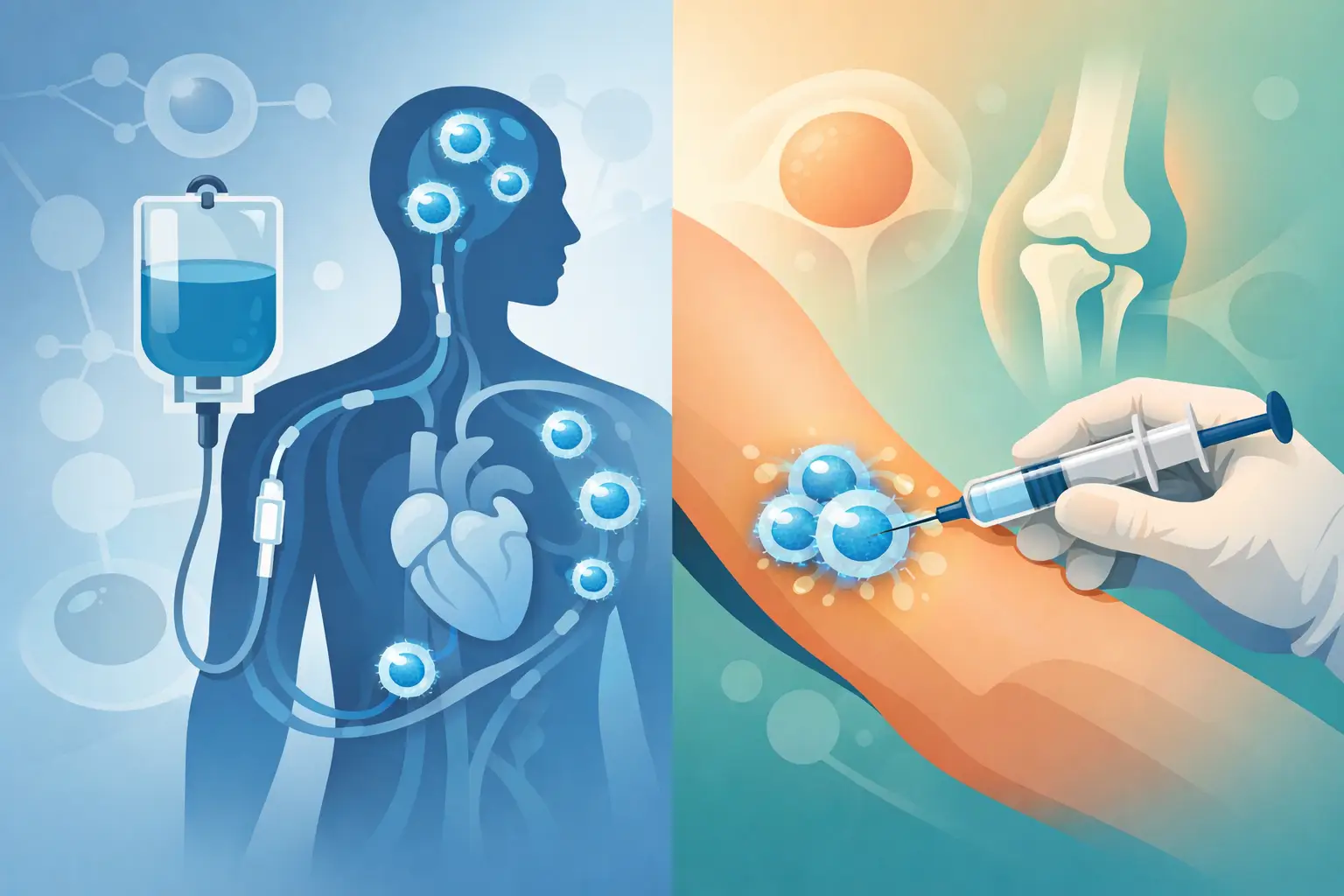
If you are comparing iv stem cells versus local injection, you are already asking the right question. The delivery method is not a small detail. It can shape how targeted the therapy is, how quickly you may notice changes, what kind of goals make sense, and how your overall treatment plan should be built.
A lot of people come in thinking one route is automatically better. That is usually not how this works. The smarter lens is match. Match the cells to the goal, the route to the tissue, and the protocol to the person. If your focus is system-wide recovery, inflammation balance, or broader wellness support, IV delivery often enters the conversation. If the issue is more localized, like a joint, tendon, or specific pain point, local injection may be the more logical play.
How iv stem cells versus local injection actually differs
At the highest level, IV stem cells are delivered into the bloodstream, while local injections place cells into or around a specific area of concern. That sounds simple, but the practical difference is significant.
With IV delivery, the goal is often broader distribution. This route is usually discussed when someone wants a more systemic approach, especially when the target is not one single structure. People looking at recovery, general regenerative support, or whole-body optimization often ask about IV because it fits that bigger-picture frame.
Local injection is different by design. It is about precision. If the knee is the issue, or the shoulder, or a specific soft tissue structure, placing cells directly into that region can make more sense than sending them through circulation and hoping enough activity occurs at the exact site that needs support.
That is the core difference in iv stem cells versus local injection – systemic reach versus localized targeting.
When IV stem cells may make more sense
IV delivery tends to appeal to people who are not chasing one narrow outcome. They are often looking for support around inflammation, recovery capacity, performance resilience, or a more global regenerative strategy. For that reason, IV can fit well into a broader wellness or longevity plan.
This route also feels more approachable to some patients because it is less about injecting into a specific joint or body structure. The procedure itself may seem simpler from a comfort standpoint, even though the decision behind it should still be highly individualized.
That said, broader is not always better. An IV approach may be attractive, but if your main issue is one clearly defined orthopedic area, the systemic path may not be the most efficient route. This is where expectations matter. Some people want whole-body support. Others want a direct answer for one stubborn body part. Those are not the same objective.
When local injection may be the stronger option
Local injection usually enters the conversation when a problem has an address. If there is a specific joint, tendon, ligament, or region that is not performing, not recovering, or not responding the way it should, local placement offers a more targeted strategy.
For active adults, this often feels intuitive. If the problem is the shoulder, why not treat the shoulder? That logic is one reason local injections remain a major part of regenerative treatment planning.
Targeting can be especially relevant when symptoms are mechanical, localized, or tied to movement in one area. It may also be preferred when someone has already tried more general wellness interventions and now wants a more focused protocol.
Still, precision comes with trade-offs. Local injections can be more procedure-specific, and the tissue environment matters. The exact location, severity of the issue, and quality of surrounding tissue all influence what kind of response is realistic.
IV stem cells versus local injection for pain, recovery, and performance
This is where the decision gets more practical. If your main concern is localized pain tied to one structure, local injection often deserves serious attention because it is built for tissue-level targeting. If your concern is broader recovery, training resilience, or system-wide wear and tear, IV may align better with that goal.
Performance-focused clients often sit somewhere in the middle. They may have one problem area, but they also want better overall recovery and less inflammatory drag across the board. In those cases, the best plan is not always either-or. Sometimes the right conversation is about sequencing, combination strategies, and timing.
That is one reason consultation matters so much. Regenerative medicine is not strongest when it is sold as a menu item. It performs best when the route, source, timing, and objective are aligned.
What people get wrong about iv stem cells versus local injection
The biggest mistake is assuming delivery method alone determines success. It does not. Cell quality matters. Candidate selection matters. The condition being addressed matters. The timeline matters. And your goals matter more than most people realize.
Another common mistake is chasing the least invasive option without asking whether it fits the target. Easy is not always effective. On the other side, some people assume the most direct option must be the strongest. That is not automatically true either. If the goal is systemic support, a local injection may be too narrow.
There is also a marketing problem in this space. People are often told that one route does everything. That is usually a red flag. Sophisticated treatment planning leaves room for nuance. The better question is not which method sounds more advanced. It is which method fits the biology and the outcome you want.
How a consultative approach changes the decision
This is not a category where self-diagnosis is enough. A real consultative process should look at your symptoms, history, goals, activity level, and whether the issue is diffuse or localized. It should also address what kind of response is realistic, what the recovery process may involve, and whether other regenerative tools belong in the conversation.
That matters because stem cell delivery does not happen in a vacuum. Some patients are building a larger optimization stack around recovery and inflammation management. Others are trying to solve one stubborn limitation that keeps interfering with training, mobility, or daily life. Those are different use cases and should be treated like different use cases.
At Stem Cells and Peptides, that is why a guided next step makes more sense than generic advice. The route should follow the goal, not the trend.
IV stem cells versus local injection and the importance of expectations
One of the smartest things you can do before choosing a route is define what success looks like. Are you trying to support overall wellness? Improve recovery capacity? Address persistent discomfort in one joint? Get back to a more active baseline? Those answers narrow the field quickly.
It is also smart to think in time horizons. Some people want support for long-term resilience. Others want help with a current physical bottleneck. The treatment route may shift depending on whether the objective is broad maintenance or concentrated intervention.
This is where people often need the most honesty. Regenerative medicine can be powerful, but it is not magic and it is not one-size-fits-all. The best candidates are usually the ones who understand that the right protocol is built, not guessed.
Which option is better?
If you want a simple winner in the iv stem cells versus local injection debate, you probably will not get one. The better option depends on whether your priority is systemic support or targeted treatment.
IV may be the better fit when the goal is more global and the treatment plan is aimed at broader regenerative support. Local injection may be the better fit when there is a specific area that needs direct attention. In some cases, a combination strategy may deserve discussion, especially for people balancing localized dysfunction with bigger-picture performance or recovery goals.
That is the real answer, even if it is less flashy than a hard yes or no. Good medicine is not about forcing every problem into the same delivery method. It is about choosing the route that best matches the terrain.
The best next move is not guessing which option sounds stronger. It is getting clear on what your body is asking for, what your goals actually are, and whether the plan in front of you is built around precision instead of hype.