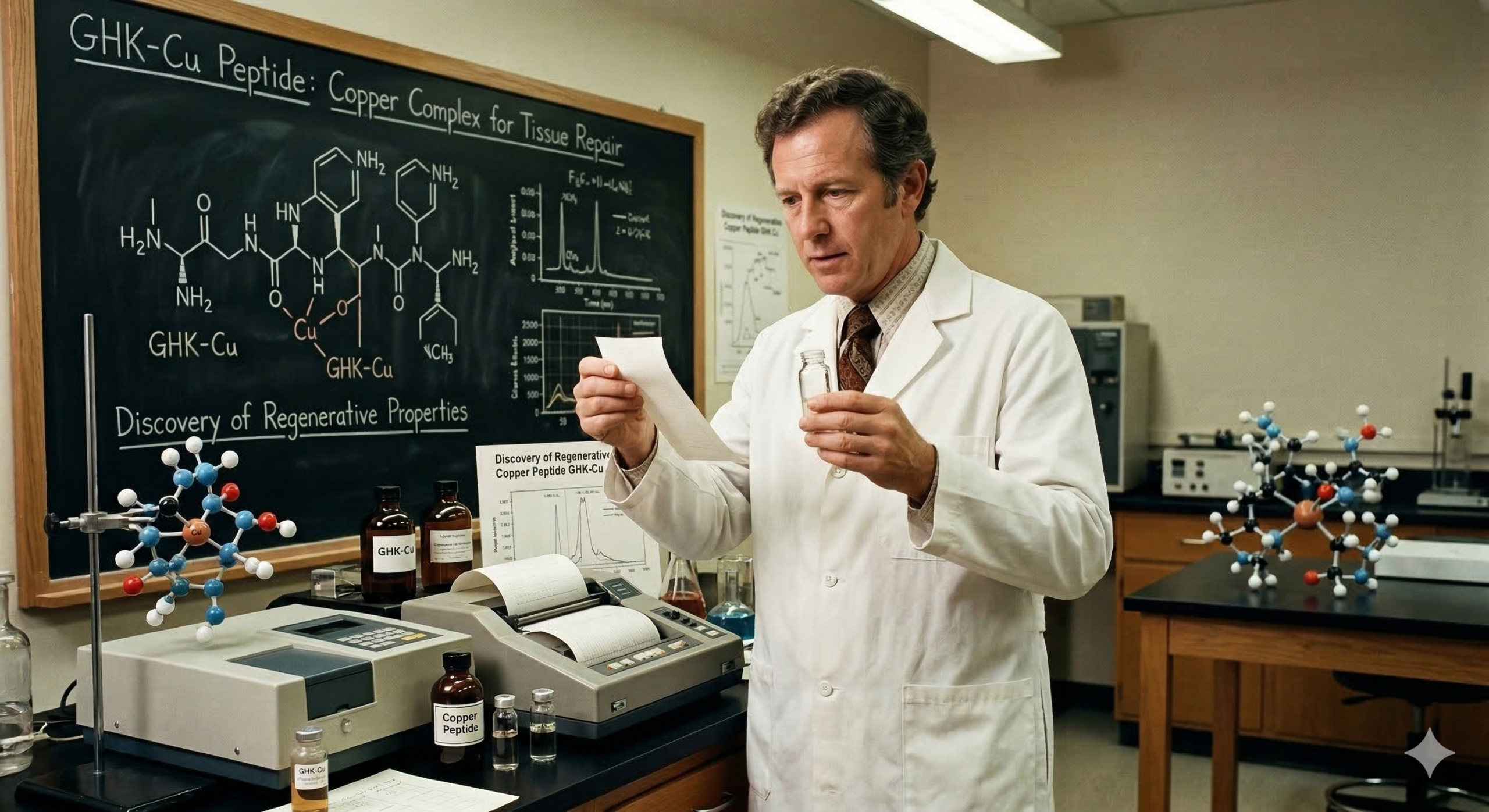
Who is Dr. Loren Pickart and what is GHK-Cu?
Dr. Loren Pickart is a researcher known for his work on copper peptides—especially a naturally occurring peptide called GHK and its copper-bound form GHK-Cu.
Pickart earned wide credit for identifying GHK’s biological significance after he observed that certain components in human blood seemed to influence tissue repair and youthful function. Over time, his work helped popularize the idea that specific small peptides can act as “signals” in the body. Molecules that may influence how cells behave, particularly in skin and connective tissue.
The discovery story: how GHK- Cu became important
The origin story most often described in peptide literature is that GHK was first noticed in human plasma as a factor associated with tissue repair and regenerative activity. The peptide sequence Gly-His-Lys (GHK) was identified and studied for its ability to bind copper.
Copper is an essential trace mineral involved in many enzymatic reactions. When GHK binds copper (forming GHK-Cu), it becomes a complex that has been studied for potential roles in:
- Skin remodeling and appearance
- Wound healing pathways
- Collagen and elastin-related processes
- Anti-inflammatory signaling in certain contexts
- Support of antioxidant defenses
It’s important to keep the language precise: much of the enthusiasm around GHK-Cu comes from laboratory and preclinical research, plus topical cosmetic use. The strength of evidence varies depending on the specific claim, route of use (topical vs. injectable vs. oral), formulation quality, and study design.
What is GHK-Cu?
GHK-Cu is a complex made from:
- GHK: a tripeptide (three amino acids: glycine, histidine, lysine)
- Cu: copper ion
GHK is found naturally in the human body and has been detected in blood plasma, saliva, and urine. Levels may change with age. When bound to copper, GHK-Cu has been studied as a bioactive signaling molecule.
Why copper binding matters
Copper binding can change how a peptide behaves in biological systems. In the case of GHK, the copper-bound form is often the focus because it appears to interact with pathways involved in tissue repair and extracellular matrix maintenance.
Researchers have explored mechanisms such as:
- Modulation of genes involved in tissue remodeling
- Influence on growth factors and cytokines
- Support of enzymes tied to collagen organization
Again, the key point is that these are areas of investigation. Some findings are promising, but translating mechanisms into clear clinical outcomes is a separate step.
What GHK-Cu is commonly used for
GHK-Cu is most commonly encountered in topical skincare products. In that context, it’s often marketed for:
- Improving the look of fine lines and wrinkles
- Supporting firmness and elasticity
- Helping the appearance of damaged skin
- Supporting overall skin tone and texture
Topical copper peptides have a longer history in the cosmetic world than many other peptides because they’ve been studied for skin-related effects and are relatively common in anti-aging formulations.
Research vs. Marketing for GHK-Cu
You’ll often see strong marketing claims around GHK-Cu. A practical way to evaluate them is to separate:
- Cosmetic claims (appearance-based)
- Biological mechanisms (lab findings)
- Clinical outcomes (human trials with measurable endpoints)
The strongest, most consistent use-case is still topical skincare and skin appearance. Claims beyond that require careful sourcing and should be stated as “studied for” rather than “proven to.”
Why Someone Might Use GHK-Cu as an Injectable Peptide (Educational Overview)
People usually hear about GHK-Cu in skincare because copper peptides are common in topical anti-aging products. But in peptide communities, some people also discuss injectable use. The reasons typically come down to a desire for system-wide effects rather than surface-level, cosmetic changes.
1) Interest in tissue repair and recovery support
GHK-Cu is a naturally occurring copper-peptide complex found in the body. It has been studied for roles in signaling related to tissue remodeling and repair pathways. Because injections deliver compounds beyond the surface of the skin, some people pursue injectable GHK-Cu hoping it may support recovery from:
- Training-related wear and tear
- Minor injuries
- General “recovery optimization” goals
2) Collagen and extracellular matrix signaling
One of the most talked-about areas for GHK-Cu is its relationship to collagen, elastin, and other components of the extracellular matrix. In topical form, this is often framed as improving the appearance of our skin. With injections, the motivation is often broader: people hope that systemic exposure could influence connective-tissue signaling in a way that supports overall tissue quality.
3) Skin goals beyond topical products
Some users pursue injectable GHK-Cu for skin-related goals when they feel topical products aren’t enough, or when they want an approach they believe could work “from the inside out.” Commonly stated goals include:
- Skin texture and firmness
- Overall “glow” or skin quality
- Support after cosmetic procedures
That said, topical copper peptides have a longer track record in consumer use than injectable protocols.
4) Inflammation and oxidative stress narratives
GHK-Cu is discussed in relation to anti-inflammatory signaling and antioxidant defense mechanisms. This is another reason some people consider injections: they’re aiming for whole-body support rather than localized effects.

Enter LifeWave X39: what it is
LifeWave markets X39 as a wearable phototherapy patch (often described as “light therapy” or “photobiomodulation” technology). The company describes the patch as non-transdermal, meaning it doesn’t deliver a drug through the skin, and says it reflects or interacts with light and heat to influence the body.
LifeWave’s marketing commonly connects X39 to the idea of increasing or “activating” GHK-Cu in the body.
What does “activation of GHK-Cu” mean?
People use “activation” in everyday language to suggest that the body produces more of a molecule or shifts it into a more biologically active form. With GHK-Cu, marketers and users usually frame the claim like this:
- The patch influences the body’s signaling
- This leads to increased GHK-Cu
- Which then supports repair, recovery, or “regeneration”
Phototherapy and the body: the general concept
Phototherapy is a broad term. In clinical medicine it can mean many things, from UV therapy for skin conditions to red/near-infrared light used in photobiomodulation.
In the wellness space, people most often talk about photobiomodulation (PBM), which uses specific wavelengths of light to influence cellular activity—often by targeting mitochondria and energy metabolism.
How this relates to peptides
If light-based interventions influence inflammation, circulation, oxidative stress, or cellular signaling, it’s plausible that downstream molecules (including peptides) could change as part of the body’s response.
However, plausibility is not the same as proof. For any specific product claim—like “this patch increases GHK-Cu”—the strongest support would come from:
- Well-designed human studies
- Clear measurement methods (how GHK or GHK-Cu was measured)
- Independent replication
How LifeWave X39 is marketed around GHK-Cu
LifeWave’s messaging often positions X39 as a convenient, wearable approach that supports the body’s natural processes. The GHK-Cu angle is attractive because GHK-Cu is already associated (in research and cosmetics) with tissue repair and youthful skin appearance.
Here’s a clear, reader-friendly way to frame it:
- GHK-Cu is a naturally occurring copper peptide complex studied for roles in tissue repair and skin remodeling.
- LifeWave X39 is a wearable patch marketed as a phototherapy-like product.
- The company claims the patch can increase or “activate” GHK-Cu in the body.
- Evidence quality matters: readers should look for independent, peer-reviewed human data to confirm the magnitude and reliability of such effects.
Disclaimer
This content is not intended to diagnose, treat, cure, or prevent any disease. Always consult a qualified healthcare professional for personal medical guidance.