
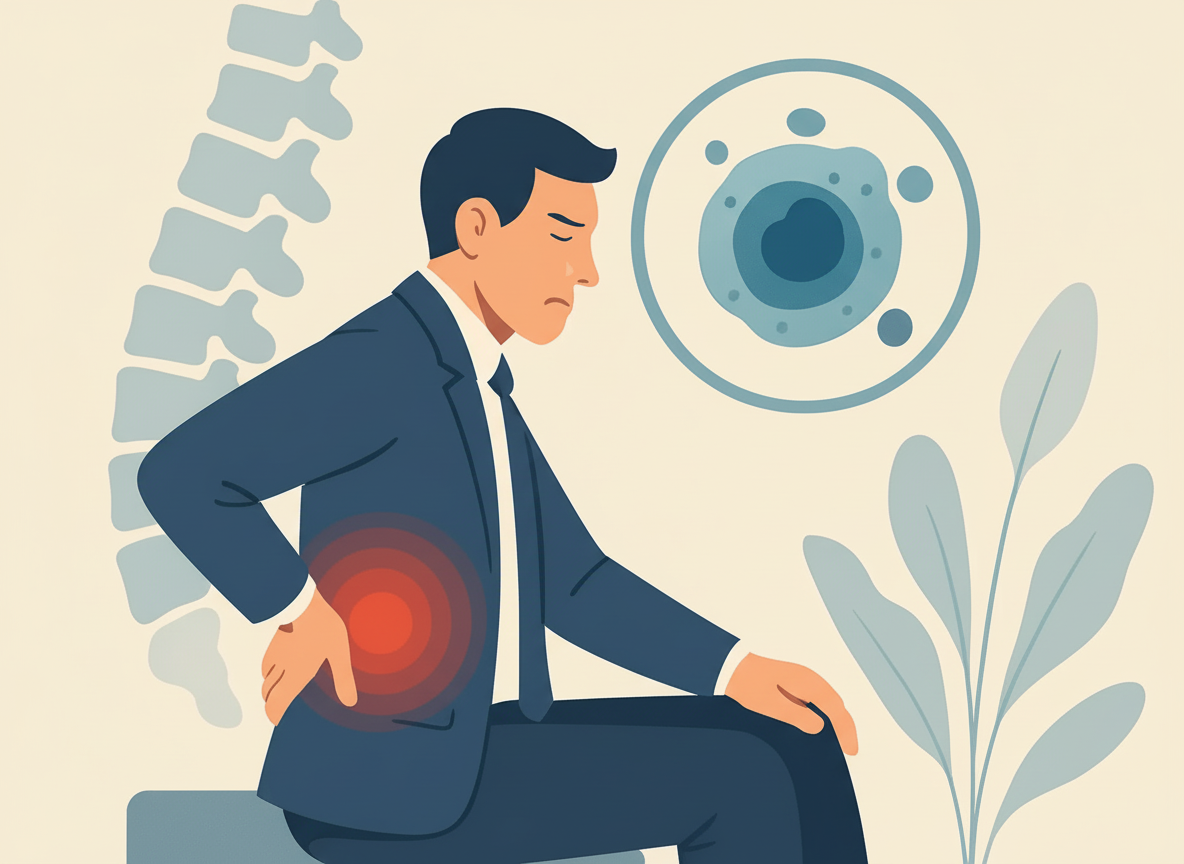
Back pain has a way of shrinking your life without asking permission. One week you are training, traveling, and sitting through long dinners. The next week you are doing mental math about every chair, every car ride, every lift, every step off a curb.
If you are the kind of person who thinks in terms of performance and longevity, you have probably already done the basics: better training mechanics, smarter recovery, targeted physical therapy, maybe injections, maybe imaging. The question becomes less “what is back pain?” and more “what is the next lever to pull when the usual levers are tapped out?”
That is where stem cell therapy for back pain enters the conversation. Not as a magic reset, not as a guaranteed alternative to surgery, but as a regenerative-focused option that aims to change the local tissue environment instead of only numbing symptoms.
What stem cell therapy for back pain is actually targeting
Most chronic back pain is not one simple problem. It is often a stack of issues: disc degeneration, irritated facet joints, ligament laxity, nerve sensitization, muscle guarding, and sometimes true nerve compression. Stem cell approaches are usually discussed in the context of two main targets: degenerative discs and arthritic or inflamed spinal joints (often the facet joints or SI joint region).
Mesenchymal stem cells (MSCs) are the headline here. They are studied because they can signal and coordinate repair processes through paracrine effects, meaning they release bioactive factors that influence inflammation, local immune response, and tissue remodeling. In plain terms, the goal is not that cells “turn into a new disc overnight.” The goal is to shift the biology of the area toward healing and away from chronic breakdown.
That nuance matters because it sets expectations. If your pain is driven by a large disc herniation physically compressing a nerve root, biology alone may not solve a mechanical problem. If your pain is driven by chronic inflammation and degeneration with no major compression, you may be in a different category.
Who tends to be a stronger candidate (and who usually is not)
The best use case is often the person with persistent back pain who has done conservative care seriously, has imaging that matches the story, and wants a next step that is still oriented toward function and recovery.
A stronger candidate often looks like someone with mild-to-moderate degenerative disc disease, painful facet arthropathy, or recurring back pain that flares with load, posture, or endurance. The pain pattern is consistent and the diagnosis is not vague. They can still train or move, but they pay for it later.
On the other hand, there are scenarios where it depends, and sometimes the answer is a hard no. Red flags include progressive neurological deficits, bowel or bladder changes, suspected infection, unstable spine, or severe stenosis with clear nerve compromise. If the structure is unstable or the nerve is truly trapped, regenerative therapies may be the wrong tool.
Also, if your pain is mostly referred from the hip, driven by myofascial patterns, or linked to poor sleep, stress load, and deconditioning, then a cell-based therapy might be an expensive way to avoid the boring work that actually fixes the problem. The smartest clinics will tell you that up front.
The process: what people are really signing up for
Most patients want to know what will happen, how long it takes, and what the recovery looks like.
First comes evaluation. A serious workup should include a detailed movement and symptom history, a review of prior treatments, and imaging when appropriate. For many back pain cases, MRI findings are helpful, but they have to match your symptoms. Plenty of people have “bad looking” discs with no pain, and plenty of people have pain with minimal findings.
Then there is the procedure itself. Protocols differ by provider and by the type of cells used. With MSC-focused therapies, the delivery may be targeted to areas such as a facet joint, SI region, or in some settings the disc space itself. The technical skill and imaging guidance used during injection matter. You are not just buying a product, you are buying precision.
Recovery is usually not “bed rest,” but it is also not “back to deadlifts tomorrow.” Most reputable programs use a staged return. Think in terms of protecting the area early, then gradually reloading tissues while inflammation calms and mobility returns. Many people underestimate how much the rehab side influences their outcome.
Outcomes: the honest version
If you are shopping for guarantees, regenerative medicine will frustrate you. Response varies.
Some people report meaningful improvements in pain, stiffness, and activity tolerance over weeks to months. Others get partial improvement, like fewer flare-ups or better recovery after sitting and travel. Some people feel little to no change.
What drives the spread? Usually a mix of diagnosis accuracy, procedure quality, lifestyle variables (sleep, training load, body composition), and the underlying stage of degeneration. Early-to-mid stage problems tend to be more responsive than end-stage collapse. Also, if you have multiple pain generators and only one is treated, the remaining issue can keep the pain signal alive.
The timeline is another place people get tripped up. You may not feel “better” immediately. In fact, you might feel sore for a short window. Many patients evaluate progress too early, then later realize they have more good days, need fewer pain workarounds, and can tolerate training or long workdays again.
Risks and trade-offs you should take seriously
“Natural” does not mean “risk-free.” Any injection-based therapy has potential downsides.
There is the basic procedural risk: infection, bleeding, or a flare of pain. There is also the strategic risk: spending time and money on a therapy that is not the right match for your pain generator.
And then there is the market reality: quality varies. Cells are not all the same, processing standards vary, and “stem cell” is sometimes used loosely in marketing. If you care about outcomes, you want clarity on what is being used, why it is being used, and how it is handled.
One more trade-off: chasing procedures can become a way to avoid fundamentals. If you inject but keep living like your spine is indestructible, you can end up right back where you started. The most successful patients treat regenerative therapy as a force multiplier on good training, recovery, and biomechanics.
How to vet a provider without getting lost in hype
You do not need a PhD to ask the right questions. You need a standard.
Ask what diagnosis they are treating and how they confirmed it. Ask where the injection is going and why that target makes sense. Ask what the realistic range of outcomes is for someone with your exact presentation. Ask what rehab looks like, and whether they coordinate it.
You also want transparency. If a clinic cannot explain the plan in plain English, that is a problem. If they promise certainty, that is also a problem. The best operators sound confident, but not absolute.
If you want a consultative next step with a team that lives at the intersection of regenerative wellness and performance-minded outcomes, you can schedule a conversation through Stem Cells and Peptides and get routed to the right pathway based on your goals.
Where stem cells fit alongside other back pain strategies
Most people do not need an either-or decision between stem cells, physical therapy, and other interventions. The more useful question is sequencing.
If you have not done a focused, progressive rehab plan, start there. A spine that cannot tolerate load will keep sending danger signals no matter what you inject. If you have done that work and keep hitting the same ceiling, regenerative options become more interesting.
If your pain is largely inflammatory and joint-driven, targeted injections can sometimes be part of a plan to calm the system while you rebuild capacity. If the issue is disc-related, the conversation becomes more specific and more dependent on imaging, symptom pattern, and severity.
If surgery is on the table, it is worth separating fear from facts. Some surgical interventions are truly appropriate and can be life-changing when there is clear mechanical compromise. The goal is not to “avoid surgery at all costs.” The goal is to pick the right intervention for the right problem at the right time.
Also check out the LifeWave X39 and X49 to help manage inflammation and activate stem cells.
The mindset that gets the best results
People who do best with stem cell therapy for back pain tend to treat it like a performance project, not a lottery ticket.
They get clear on the pain generator. They clean up the obvious variables: sleep, daily steps, body weight if needed, and training patterns that keep provoking flare-ups. They follow a reload plan instead of testing their spine every weekend. They also track progress in a way that matters, like sitting tolerance, morning stiffness, training volume, and how quickly they bounce back from a long day.
If you take that approach, regenerative therapy becomes less about hope and more about strategy: a premium option designed to help you stack more good weeks in a row.
Closing thought: the win is not “zero pain forever.” The win is getting your back out of the driver’s seat so you can focus on building a body that keeps up with your life.